 Tool Casebook
Model Guides
DeepSeek V4.1 Flash 1017: What changed and where it fits
A practical guide to DeepSeek V4.1 Flash 1017, including coding benchmarks, vision, long context, and reasoning latency.
DeepSeek V4.1 Flash 1017 is the October 17, 2026 update to DeepSeek V4.1 Flash. It is worth testing if you use a model to work through coding tasks or process long text inputs. DeepSeek reported higher scores on coding and reasoning benchmarks, along with shorter outputs and faster task completion in its evaluations. The direct DeepSeek API still uses the model name deepseek-flash. DeepSeek release announcement · DeepSeek API changelog
What changed in the 1017 release
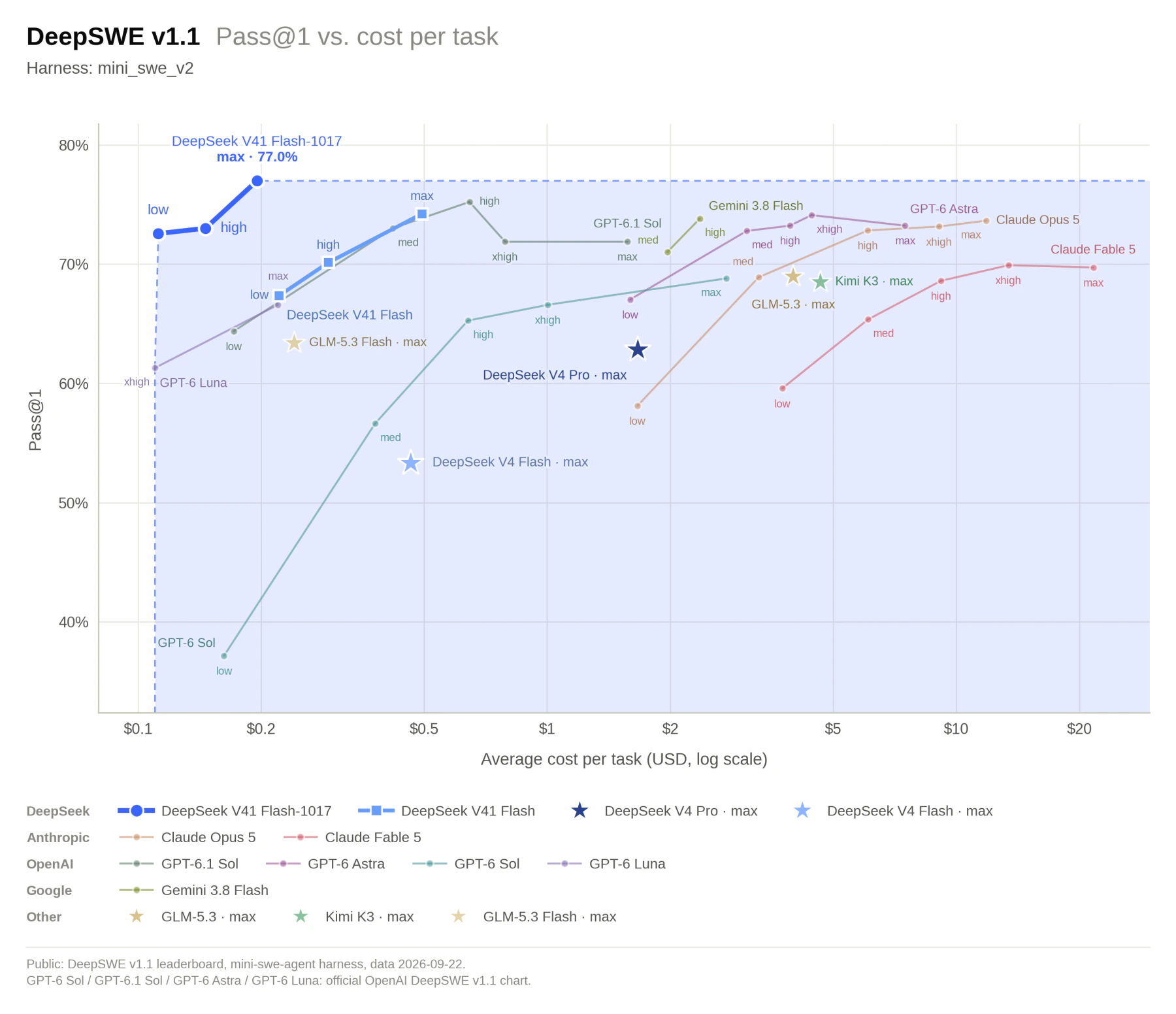
DeepSeek’s model card reports the following results for the October update and its predecessor. The results come from DeepSeek’s evaluation setups, including Claude Code for Terminal-Bench 4.0 and Mini-SWE-V2 for DeepSWE. DeepSeek model card
| Benchmark | V4.1 Flash | V4.1 Flash 1017 |
|---|---|---|
| Terminal-Bench 4.0 | 31.2 | 42.3 |
| DeepSWE v1.1 | 74.2 | 77.0 |
| ProgramBench | 20.3 | 29.1 |
The largest gain in this table is on Terminal-Bench 4.0, where the score rose 11.1 points. The improvement on DeepSWE was 2.8 points. If you want to use 1017 in a coding assistant, compare it with the original Flash model on a small set of issues from your own repository. Keep the agent and tools the same, and measure whether the patch passes tests and how much review it needs.
What the model supports
- Long context. DeepSeek’s API lists a 1 million token context window and a maximum output of 384,000 tokens. For a repository or document workflow, start with the files you expect to matter and check whether adding more context improves the answer.
- Image input. The official Flash API accepts images and returns text. This makes it a candidate for interpreting screenshots or answering questions about charts. Check a few small labels and axis values against the original when you evaluate it.
- Tool calls and JSON output. The official API supports both. For a support workflow, you could use tool calls to retrieve a record and JSON output to return a structured summary. Test whether the model selects the right tool and validate the returned fields in your application.
DeepSeek publishes the weights under the MIT license. The official model card also documents prompt encoding for thinking mode, tool calls, and image inputs, which is useful if you plan to host the weights yourself. DeepSeek API specifications · DeepSeek model card
What Artificial Analysis measured
Artificial Analysis evaluated the 1017 release at three reasoning settings. In its November 24, 2026 snapshot, the max setting scored 33 on the Intelligence Index v5.0.1, compared with 29 at high and 19 with reasoning disabled. On DeepSeek’s API, the max setting took about 39 seconds to produce the first answer token, compared with about 21 seconds at high and 1 second with reasoning disabled. Artificial Analysis model evaluation
The gap matters for interactive tools. A coding task that can run in the background gives you room to test whether the higher score translates into more usable results. For a user waiting on screen, measure time to first answer on the endpoint you plan to deploy. The latency figures above come from DeepSeek’s API.
Which setting should you try first?
For a text task with a straightforward output, such as extracting fields from support tickets, start with reasoning disabled and count how many results pass a schema check. For a coding task that requires tracing a failure across several files, try high and max on the same issues, then compare test pass rates, time to complete, and the amount of human correction. A higher benchmark score gives you a reason to test a setting on your workload.
Where to try DeepSeek V4.1 Flash 1017
- TokenRouter is an option for testing text workloads at 75% off DeepSeek’s direct peak rates for uncached input and output. As of November 24, 2026, it lists
deepseek/deepseek-v4.1-flash-1017at $0.075 per million input tokens and $0.30 per million output tokens. TokenRouter model listing · DeepSeek direct pricing - Atlas Cloud also lists the 1017 release. Try it if you already use Atlas Cloud’s OpenAI-compatible Chat Completions API or want to compare Flash with other models in the same integration. Its published rates are $0.30 per million input tokens and $1.20 per million output tokens. Atlas Cloud DeepSeek catalog · Atlas Cloud Chat API docs